
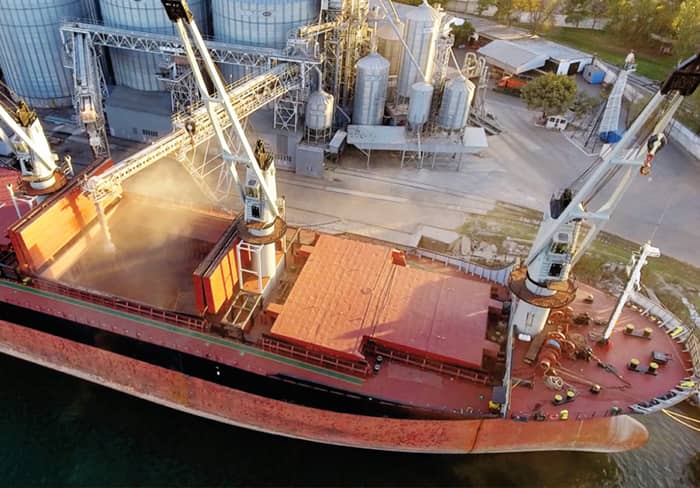
A barge is a long boat with a flat bottom that is used for transporting passengers and heavy goods through rivers, canals, and lakes. It is widely preferred over heavy freight shipping as it is economical and environment-friendly and can be easily employed for transporting bulk commodities, such as grains, coal, and petroleum. At present, the significant growth in the international trade of chemicals, minerals, petroleum, agricultural, electronic, pharmaceutical, and food products is positively influencing the demand for barge transportation around the world.
Barging is the most economical mode of cargo transportation, able to transport bulk commodities like grain, coal, petroleum and salt for a fraction of the cost of moving them by truck or rail. Barging is also the most environmentally friendly mode: one large inland towboat can push 40 barges that have the same carrying capacity as more than 2,400 trucks, resulting in significantly fewer hydrocarbons entering the air.
Barging transport your cargo in large quantities provides some of the following advantages:
Reduce cost of transport by large quantities at once. Shorten time taken to transport large quantities by barge compared to trucking. Reduce delays caused by inclement weather, mechanical breakdown and other unforeseen human or natural circumstances.

BARGE TRANSPORT
Marine-to-land barge deliveries.
We handle your transports via road from point A to point B. As a global service provider, BICKTONOU maintains an extensive network structure on various continents for road freight transports. We offer individual and economic solutions based on the weight of your goods as well as the volume.
Road haulage has a number of advantages for the customer over other types of transport, among which we can highlight:
Road transport is the cheapest option for the transfer of goods over short and medium distances compared to air or sea transport. This is because it does not require specific infrastructures to reach its destination (such as a port or airport). Of course, this is reflected in the final price.
Although road transport covers the shipment of practically all types of products or goods, a series of safety regulations are always followed to the letter to support the protection of the cargo according to its type, including the responsibility of the driver in charge of its transport.
We apply GPS geolocation to our shipments to ensure the safety of road transport. In this way we are able to observe the inconveniences related to traffic factors and thus be able to forecast delays.